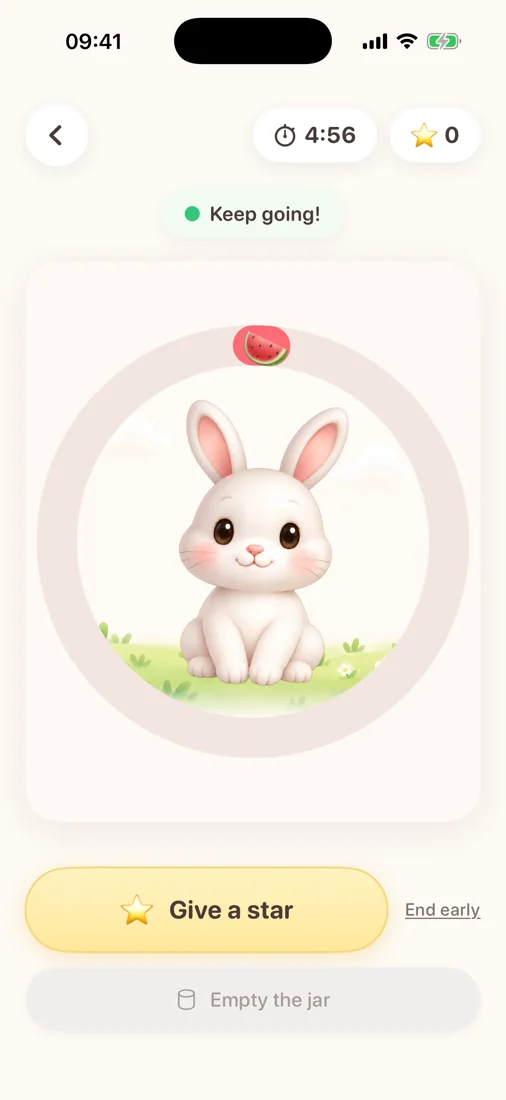
Why kids need to see time
Young children live in the present. Minutes are abstract until about age six or seven, which is why “we're leaving soon” so often ends in tears. A visual timer replaces the abstract number with a picture that changes — a ring that empties, a jar that fills, a fish tank whose water rises.
When a child can see how much is left, the end of an activity becomes predictable. Predictable endings are easier to accept than sudden ones, for children and grown-ups alike.
Five ways to show time
Munch Buddy has five timer styles, because different kids click with different pictures:
- Journey ring — a little traveller rides around the ring until it gets home.
- Glass jar — a ball plops into the jar every few seconds; kids can count along.
- Fish tank — fish splash in and the water level rises.
- Clock — a red slice shrinks on a real clock face, a gentle first step towards reading clocks.
- Big numbers — a large countdown for older kids who already know their numbers.
Toddlers usually do best with the jar or the fish tank (something fills up), preschoolers love the ring, and school-age kids often prefer the clock or numbers.
What happens when time is up
A visual timer only works if the ending is clear. In Munch Buddy, the child's chosen animal buddy calls with a real animal sound when time is up — and keeps calling until a grown-up taps to answer. It also works from the lock screen, so the timer keeps going if the phone goes to sleep.
Because the buddy calls instead of you, the message “time's up” comes from a friendly character rather than from a parent who has already said it three times.
How to start using a visual timer
- Start with something pleasant — a short play session — so the timer isn't linked only to things the child dislikes.
- Show the timer before you start and say what will happen when it ends.
- Keep the phone or iPad where the child can see it.
- When the buddy calls, follow through. Consistency is what makes a timer trustworthy.